A data centre the tourist train comes home to.
Impact
STAND 08/2026
Quedlinburg has been a UNESCO World Heritage site since 1994: 24,000 inhabitants, a thousand years of timber framing, and in the middle of it a black tower that stood empty for years. What it becomes gives the town heat, trade tax and a place that can be walked into.
The Bimmelbahn
The tourist train through the old town ends at a bay on the Cube's ground floor.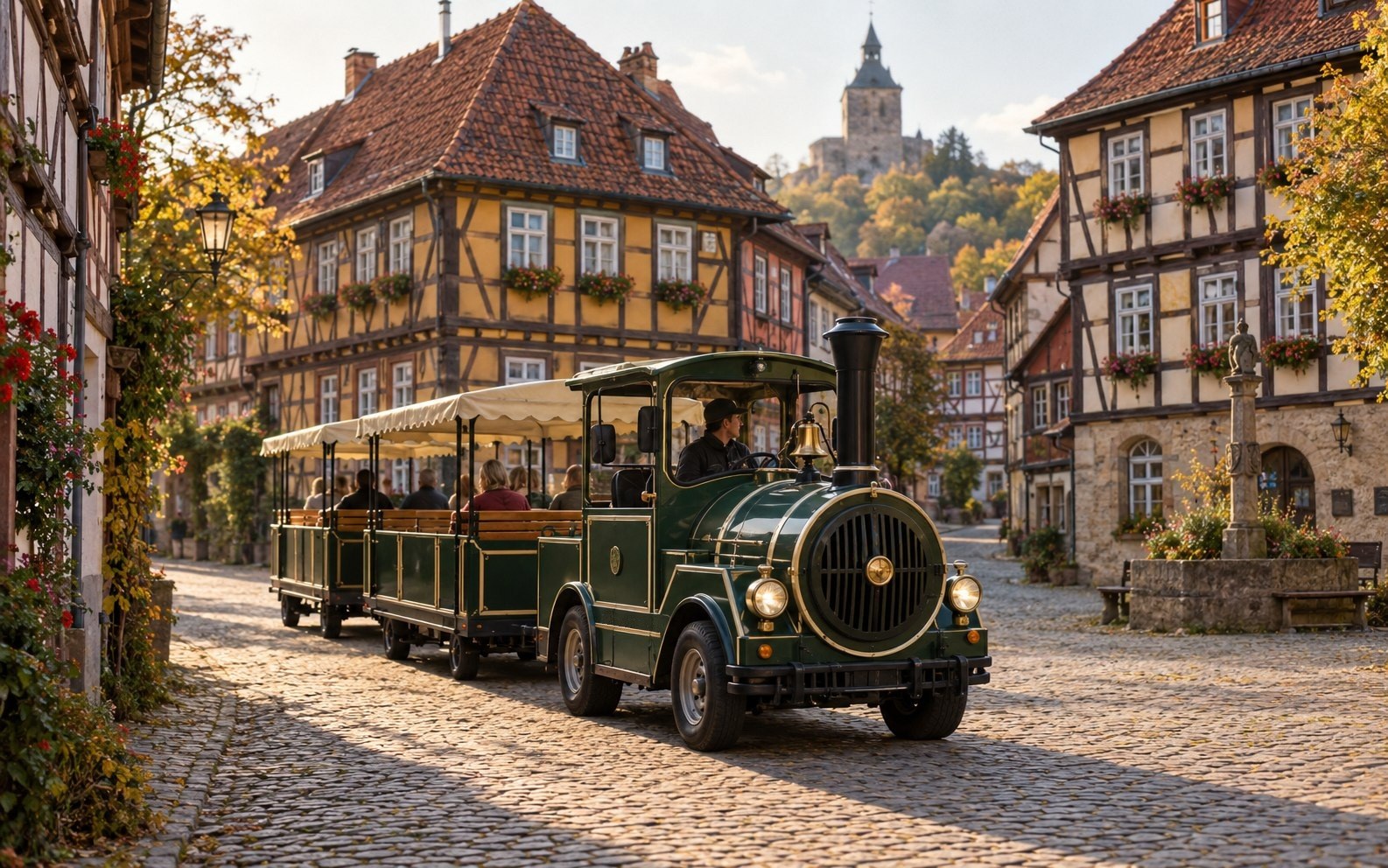
VISUALISATION · generated image, not a photograph
The Quedlinburg Bimmelbahn runs from the market square through the old town to the castle hill – a round trip of about 45 minutes, narrated live by the driver, in season. Its bay is on the ground floor of this building. Whoever arrives with it steps off, crosses the corridor and is standing in the exhibition.
A data centre is normally a fence with a camera on it. This one has an address, a door and a timetable.
- Departures
- operator's published timetable
- Duration
- approx. 45 minutes
- Season
- summer season
- Exhibition
- 144 m², directly opposite
The heat
The heat is designed to feed the town's district-heating network.Electricity that computes becomes heat, all of it: about 21,900 MWh a year at the 3 MW expansion case, which is 2.5 MW of IT load over a full year. Quedlinburg already has a network for it – 9 km of district heating, roughly 43 GWh a year, 99 transfer stations. The heating plant stands on the same street as the Cube, and the nearest 175 homes on that network are 200 metres away.
The network runs past the door
- Network operator
- Stadtwerke Quedlinburg
- Their plant
- Süderstadt, 3.5 MW CHP
- Address
- Klopstockweg 21 – our street
- Network
- 9 km · 43 GWh/yr · 99 stations
- Nearest load
- 175 homes, 200–670 m
A connection is therefore a question of a transfer station and a temperature – not a question of kilometres of new pipe. Those conversations are ahead of us; the network figures come from public sources.
Heat against the town's own network
Quedlinburg district heating, full year
43,000
Waste heat from this building
21,900
Legally required from commissioning (15 %)
3,285
about 7.6 percent of everything the town's network delivers in a year
MWh/yr
Efficiency
The cleanest electricity is the kind never drawn.A PUE of 1.20 means every kilowatt-hour of compute carries 0.20 kWh for cooling, UPS and losses. The German installed base averages 1.55. At the same compute load that is 0.875 MW less – continuously.
- Electricity never drawn
- 7,665 MWh/yr
- Emissions avoided
- approx. 2,600 t CO₂/yr
Electricity drawn at 2.50 MW of compute
The same IT load at the German average
33,945
at PUE 1.55 (Bitkom)
This building
26,280
at PUE 1.20 – about 23 percent less
MWh/yr
The law
Germany has the strictest rules in Europe. Here is where this building stands against each.The Energy Efficiency Act applies to data centres from 300 kW – this one has 3,000. Four requirements, and where the project stands.
PUE of at most 1.2
Reached by design: cooling directly in the rack row, free cooling at grade in the yard, short runs. Chillers run roughly 150 hours a year.
100 % renewable electricity, on a balance-sheet basis, from 2027
450 kWp of photovoltaics are already mounted on facade and roof; the remaining demand is procured as renewable supply.
Energy management system, EnEfG §12
Designed to EnEfG §12: metering per circuit and per load, one operations picture, and the reporting path that a certified system is audited against. Certification follows commissioning; it is not a design decision.
15 % waste heat reuse from commissioning
The town's district heating network runs past the door. What remains to be settled is the transfer station, the heat pump that lifts 35 °C to network temperature – and the agreement with the network operator.
The ground
Not one square metre is newly sealed.The building has stood on this plot since 1983. It is converted, not replaced: no excavation, no new ground, no second structure. Of roughly 9,500 m² two buildings are occupied; the cooling needs about 161 m² of the open ground.

AERIAL · the Cube and the open ground that stays open
- The Cube
- 622 m²
- Neighbouring building
- 274 m²
- open ground
- 8,601 m²
Areas from the land register, drawn to scale.
What the town gets
The building runs unmanned in normal operation. The benefit to Quedlinburg is not in the payroll, and we say so before the first town meeting rather than after it.
Heat
Up to 3,285 MWh a year could go into the existing district heating network – arithmetically about 7.6 percent of what the town's network delivers in a year.
Trade tax and local trades
Trade tax at this location, and local trades throughout the construction period.
A place instead of a vacancy
A building with no use gets one – without a new shed appearing at the edge of town. With 144 m² of exhibition, opposite the Bimmelbahn's bay.
Sources
- 01Energy Efficiency Act (EnEfG): obligations for data centres, PUE limits and waste heat quotas
- 02Bitkom, Data centres in Germany – market developments and average PUE
- 03Federal Environment Agency: CO₂ emissions per kilowatt-hour of electricity, 2025
- 04Quedlinburger Bimmelbahn – timetable, route and running times
- 05German UNESCO Commission: Collegiate Church, Castle and Old Town of Quedlinburg
- 06District heating network and Heizwerk Süderstadt: Stadtwerke Quedlinburg
- 07Building count in the vicinity: official land register (ALKIS), LVermGeo Saxony-Anhalt